
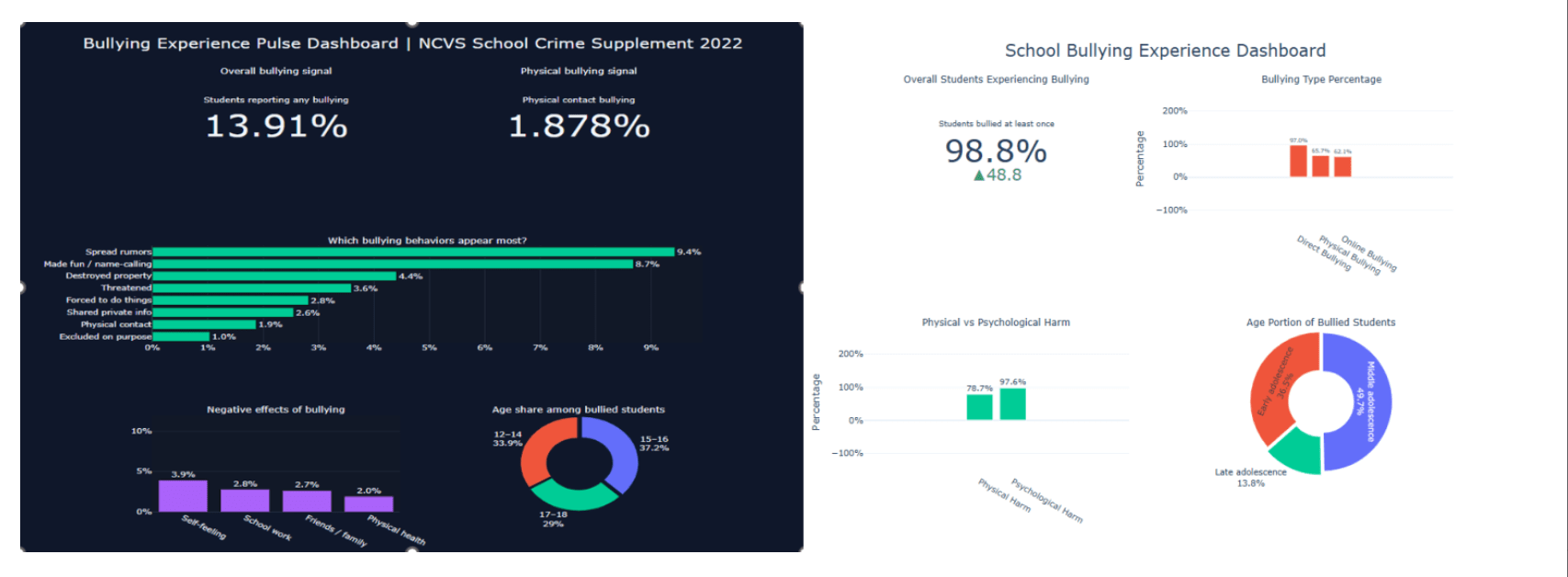
Bullying is often discussed as a childhood problem, but the data tells a deeper story. Behind every percentage lies a student experiencing fear, humiliation, exclusion, or emotional distress. As schools become increasingly connected through digital platforms, bullying has evolved beyond playground confrontations into social media attacks, rumor spreading, online harassment, and psychological abuse. The combined dashboards above present a powerful comparison between a student bullying survey and the 2022 NCVS School Crime Supplement, offering a multidimensional view of how bullying affects young people.
A Concerning Picture from the Data
The first dashboard, based on the student survey dataset, reveals that nearly 99% of respondents reported experiencing some form of bullying or victimization at least once. Direct bullying affected approximately 97% of students, while 65.7% experienced physical bullying and 62.1% reported online bullying. Physical harm was reported by 78.7%, while psychological harm reached an alarming 97.6%.
This finding is particularly important because it highlights that the most severe consequence of bullying is not necessarily physical injury but emotional and psychological damage. Anxiety, fear, loss of confidence, depression, social withdrawal, and academic decline often persist long after physical wounds disappear.
The age distribution analysis indicates that middle adolescents account for nearly half of bullied students, suggesting that intervention efforts should be concentrated during the transition years of secondary education when peer influence and social identity formation are strongest.
The National Perspective: NCVS School Crime Supplement
The second dashboard provides a broader national context. Approximately 13.9% of students reported experiencing bullying, with behaviors such as rumor spreading and name-calling appearing most frequently. Physical bullying represented a much smaller proportion, around 1.9%, compared with verbal and social aggression.
The analysis shows that:
Rumor spreading affected approximately 9.4% of students.
Name-calling impacted around 8.7%.
Threats and social exclusion remained common.
Physical bullying represented only a fraction of reported incidents.
This pattern reflects a growing shift in bullying dynamics. Modern bullying is increasingly relational and psychological rather than purely physical. Students are more likely to experience exclusion from social groups, online humiliation, or reputational attacks than direct physical violence.
Psychological Harm: The Hidden Epidemic
One of the most striking findings across both datasets is the dominance of psychological harm. While society often focuses on visible injuries, emotional damage is frequently more widespread and longer lasting.
Research consistently links bullying victimization to:
Depression
Anxiety disorders
Reduced self-esteem
Post-traumatic stress symptoms
Academic disengagement
School absenteeism
Increased risk of self-harm
Psychological harm rate exceeding 97%, shown in dashboard from the survey data suggests that anti-bullying strategies cannot focus solely on discipline or punishment. Schools must also address emotional recovery, resilience building, and peer relationships.
Why Traditional Anti-Bullying Programs Often Struggle
Recent research suggests that many anti-bullying technologies fail because they are designed for students rather than with students. A systematic review of participatory design in bullying interventions found that involving children and educators directly in the creation of anti-bullying tools improves engagement, contextual relevance, usability, and effectiveness. Researchers identified successful approaches including anonymous reporting systems, peer-support platforms, educational games, AI-powered chatbots, and digital storytelling applications.
The review also highlights that adolescents respond particularly well to peer-led designs, identity-relevant scenarios, and co-created interventions that reflect their real experiences rather than adult assumptions.
This insight is critical. Students understand bullying dynamics better than anyone else because they experience them daily.
What Children Themselves Want
An especially interesting study invited students aged 13–15 to design anti-bullying mobile applications themselves. The researchers discovered that students consistently proposed three major approaches:
Peer Support Systems
Safe spaces to share experiences.
Anonymous discussion forums.
Community-based encouragement.
Adult Support Mechanisms
Instant access to teachers or counselors.
Emergency reporting buttons.
Trusted adult notification systems.
Self-Help Resources
Emotional support content.
Coping strategies.
Confidence-building exercises.
Interestingly, students generally rejected surveillance-based approaches. Instead of constant monitoring, they preferred tools that empowered them to choose when and how to seek help.
This finding aligns closely with modern principles of digital wellbeing and user-centered design.
The Emerging Role of Artificial Intelligence
Artificial Intelligence has the potential to transform bullying prevention from reactive intervention into proactive protection.
1. AI-Based Early Warning Systems
Natural Language Processing (NLP) models can monitor school communication platforms, forums, and discussion boards to detect:
Harassment
Hate speech
Threats
Rumor spreading
Social exclusion patterns
Rather than punishing students automatically, AI can identify emerging risks and notify counselors before situations escalate.
2. AI Mental Health Risk Assessment
Modern large language models can analyze student journal entries, support conversations, and anonymous reports to estimate:
Emotional distress
Depression indicators
Anxiety signals
Isolation risk
Counselors can then prioritize support for vulnerable students.
3. AI-Powered Anonymous Reporting
Students often hesitate to report bullying because they fear retaliation. AI-powered reporting systems can:
Preserve anonymity.
Categorize incident severity.
Route cases to appropriate staff.
Generate response recommendations.
This reduces barriers to reporting while improving response speed.
4. Conversational AI Support Chatbots
Research has already explored anti-bullying chatbots that provide guidance, emotional support, and coping strategies. Students can discuss concerns privately and receive immediate assistance before speaking with adults.
Future systems may provide:
Emotional regulation coaching.
Conflict-resolution guidance.
Crisis escalation support.
Mental health referrals.
5. Computer Vision for School Safety
With appropriate privacy protections, computer vision systems could identify:
Physical aggression.
Dangerous crowd formations.
Repeated victim targeting.
These systems would not replace human judgment but could help staff intervene faster.
A Vision for Next-Generation Anti-Bullying Systems
Imagine a school platform combining:
AI bullying detection
Anonymous reporting
Peer-support communities
Counselor dashboards
Mental health monitoring
Educational gamification
Parent communication tools
Such a system would move beyond punishment and focus on prevention, empathy, resilience, and early intervention.
The strongest anti-bullying technologies of the future will not simply detect harmful behavior. They will empower students, strengthen peer support networks, and help educators create healthier school cultures.
Final Thoughts
The dashboards reveal an uncomfortable truth: bullying remains widespread, and psychological harm is often more common than physical harm. Yet they also point toward a solution. Research increasingly shows that effective interventions emerge when students are treated not merely as users but as co-designers of the systems intended to protect them.
Artificial Intelligence offers powerful new tools, but technology alone cannot solve bullying. The most promising future lies at the intersection of AI, education, psychology, and student participation. When intelligent systems amplify empathy, provide timely support, and empower young people to help one another, schools can become not only safer places to learn but stronger communities in which every student feels seen, valued, and protected.