
"A girl is far more responsible for rape than a boy."
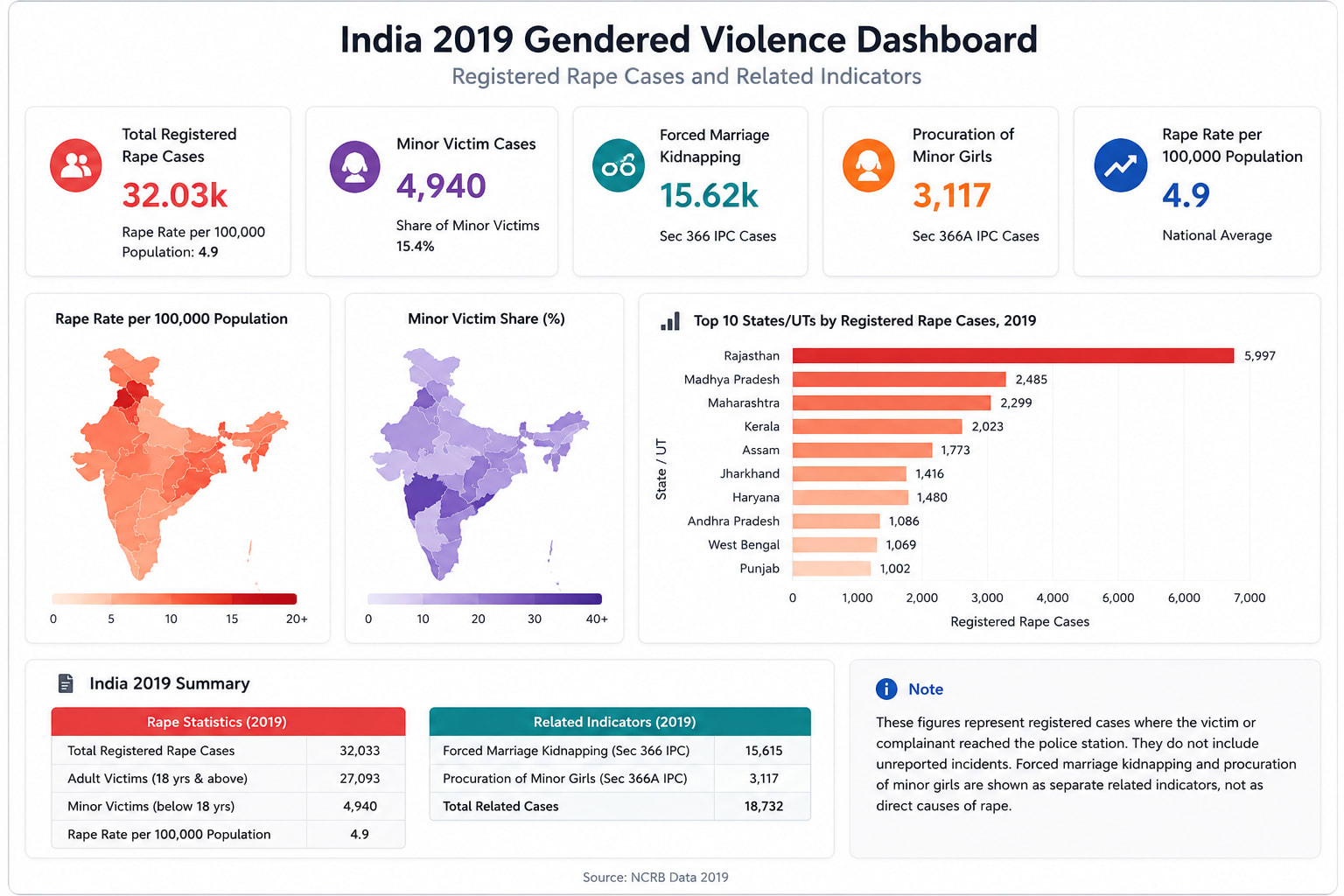
Those words were not spoken by a social media troll hiding behind anonymity. They were spoken by a convicted rapist in the aftermath of one of most horrific sexual violence cases of India. The statement is shocking not because it is rare, but because it exposes a mindset that continues to surface whenever women and girls report sexual violence. Victim-blaming does not merely insult survivors. It protects offenders. Every time responsibility is shifted from the perpetrator to the victim, justice becomes harder to achieve. The crime becomes secondary; the victim's behaviour becomes the trial. Proving depth of this mindset, we can not forget the remarks of A. P. Singh, defense lawyer of the Nirbhaya Case. According to him, autonomy and behaviour of women can be responsible for sexual violence against them. In this article, the concerning facts about rape and forced marriage culture , the difficulties faced by women across country , is explored through real data analysis. The statistics can run chill down our spine. Why did these mishaps occur ? What was the real mindset of convicted rapists and how it was formed ? I tried to dig deeper while researching the interviews of persons convicted for this kind of horrific crimes. Can artificial intelligence really empower women with their safety ? I tried to answer these questions in this article.
Tara Kaushal, an eminent journalist’s research into the minds of rapists reveals a disturbing reality: sexual violence is rarely driven by uncontrollable desire alone. Instead, it is often rooted in entitlement, power, social conditioning, and deeply internalized beliefs about gender. Through undercover conversations and interviews, she uncovered recurring patterns in how perpetrators justified their actions. Many did not view women as autonomous individuals with equal rights; rather, they perceived women through the lens of ownership, obedience, family honour, or sexual availability. In many cases, perpetrators minimized the severity of their crimes, rationalized coercion as romance, or blamed victims for their own suffering. Such attitudes do not emerge in isolation. They are reinforced by social environments where masculinity is associated with dominance, where consent is poorly understood, and where victim-blaming narratives are normalized. When a society repeatedly asks what a woman was wearing instead of why a man committed violence, it creates fertile ground for these beliefs to survive across generations.
The numbers emerging from across the country tell a story that extends far beyond individual criminal acts. Behind every statistic is a human life altered by fear, trauma, and lost opportunities. Some regions report alarming levels of violence against adult women, while others reveal substantial numbers of minor victims whose childhoods were interrupted by crimes they could neither predict nor prevent. The prevalence of forced marriage-related abductions and crimes involving minor girls highlights that gender-based violence often exists within a broader ecosystem of control and inequality. Yet amid these challenges, technology is beginning to offer new possibilities. Artificial intelligence is increasingly being deployed to detect online harassment, identify grooming behavior on digital platforms, analyze patterns in emergency calls, and predict high-risk locations where intervention may be needed. Natural language processing systems can monitor threatening messages and abusive communication, while computer vision technologies are being explored for public-space safety applications and rapid emergency response systems. AI-powered mobile applications now provide panic alerts, route-risk assessment, location sharing, anonymous reporting channels, and multilingual support for survivors seeking help. However, technology alone cannot solve a cultural problem. Algorithms can identify risks, but they cannot replace empathy, education, accountability, and social reform. The most effective future may lie in combining human awareness with intelligent systems using AI not merely as a tool for surveillance, but as a means of empowering women, amplifying their voices, improving access to support services, and helping create a society where safety is treated as a fundamental right rather than a privilege.