
Cinema has long served as both a mirror and a molder of society. While films often claim merely to portray reality, audiences and scholars frequently ask a more complicated question: do the personal beliefs, controversies, and behaviors of filmmakers influence the stories they tell about women? The relationship between a creator's life and cinematic representation remains contested, yet recurring patterns in several high-profile cases suggest that public controversies and on-screen narratives sometimes intersect in ways that deserve critical examination. This article explores whether misogynistic tendencies observed or alleged in public life appear reflected in the gender politics of films, focusing on notable case studies from contemporary Indian cinema.
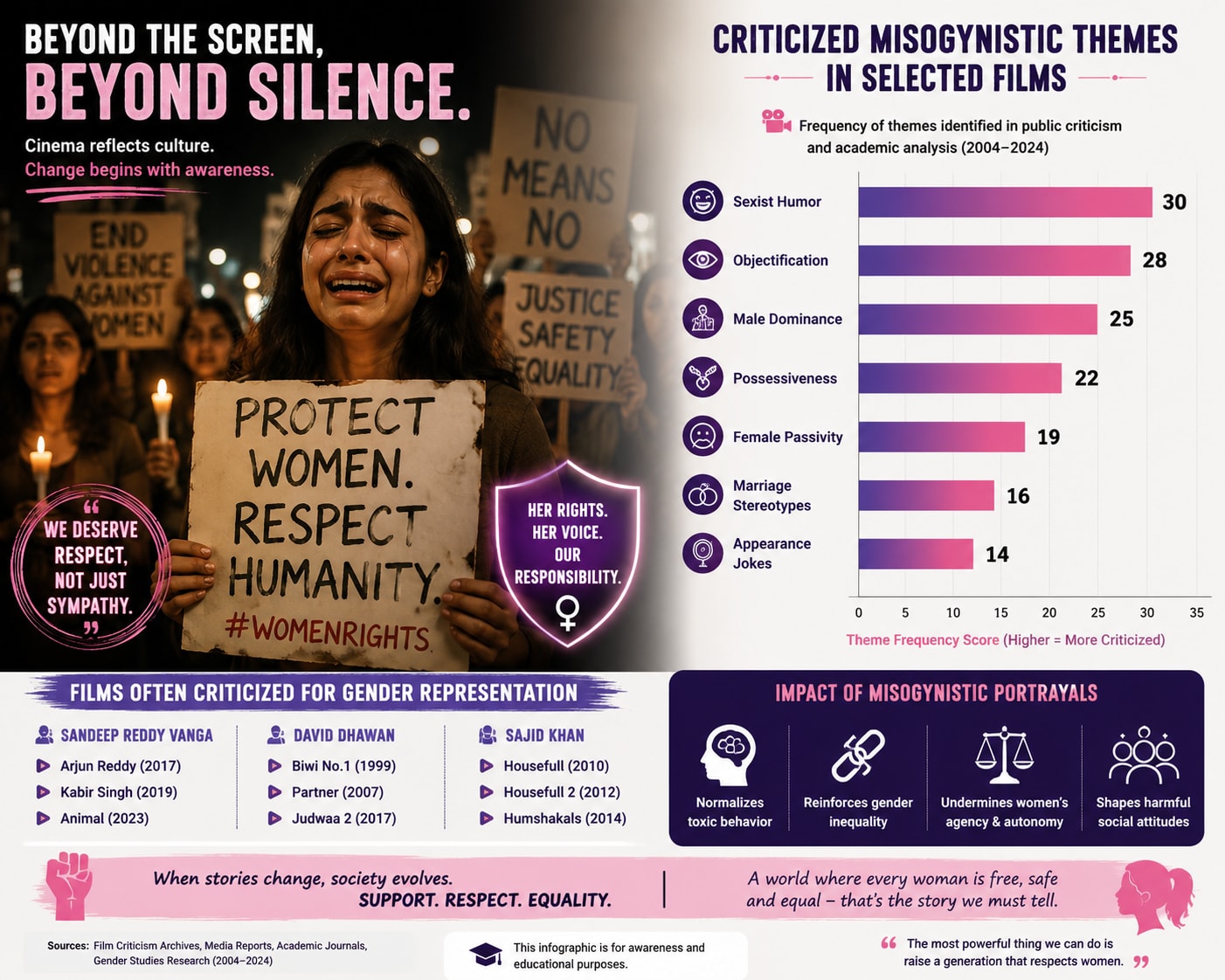
One of the most debated examples is filmmaker Sandeep Reddy Vanga. His films Arjun Reddy, Kabir Singh, and Animal became major commercial successes while simultaneously attracting criticism for their portrayals of aggressive masculinity, possessive romance, and unequal gender dynamics. Critics argued that the male protagonists exercise control over women while facing limited narrative consequences. The controversy intensified after Vanga publicly defended scenes involving physical aggression in romantic relationships and suggested that intense love may include actions such as slapping between partners. These comments generated significant backlash and reinforced perceptions that the worldview expressed by some characters in his films might align with statements made outside the screen. While Vanga has repeatedly rejected accusations of misogyny and argued that his films merely depict flawed individuals rather than endorse their actions, the overlap between his public remarks and recurring narrative themes has become a central subject of media and academic discussion. Research published in the International Journal of Social Science and Economic Research identified Kabir Singh and Animal as important case studies in contemporary debates about masculinity and misogyny in Hindi cinema.
The controversy surrounding Kabir Singh illustrates how cinema can become a site of ideological struggle. Supporters praised the film's emotional intensity and realism, arguing that flawed protagonists are a legitimate artistic choice. Critics countered that repeated depictions of possessiveness, violence, and female passivity risk normalizing harmful relationship dynamics. Academic studies examining gender representation in the film have characterized it as a prominent example of ambivalent sexism and toxic masculinity in modern Bollywood. Such critiques are significant because they move beyond individual scenes and analyze how entire narrative structures position male authority and female agency.
Another revealing case involves filmmaker Sajid Khan. Unlike debates surrounding fictional portrayals, Khan became a central figure in India's #MeToo movement when multiple women publicly accused him of sexual harassment. During the same period, critics revisited films such as Housefull, Housefull 2, and Humshakals, arguing that their reliance on sexist humour, objectification, and stereotypical portrayals of women reflected broader gender attitudes. Although allegations and film content are not equivalent forms of evidence, the coincidence prompted renewed scholarly interest in whether recurring cinematic representations can reveal deeper cultural assumptions embedded within creative work. The controversy also highlighted how audiences increasingly evaluate films through ethical lenses rather than solely aesthetic ones.
The question extends beyond individual directors and enters the broader structure of commercial cinema. Bollywood's long history includes narratives where male protagonists exercise authority over women, where female characters primarily function as romantic rewards, and where jokes depend upon humiliation or objectification. Feminist film theory, particularly the concept of the "male gaze," argues that such representations are not accidental but emerge from cultural systems that privilege male perspectives. Contemporary critics increasingly evaluate films according to agency, autonomy, dialogue distribution, narrative importance, and the consequences attached to sexist behaviour.
A particularly useful direction for future research involves computational analysis of dialogue and screenplay content. Natural language processing can quantify sexist humour, dominance language, interruptions, command frequency, gendered insults, and character agency. Researchers could calculate a dominance score by measuring how frequently male characters issue commands relative to female characters. Similarly, sentiment analysis can examine whether women are disproportionately associated with submissive language while men are associated with authority and action. Such methods would transform ideological debates into measurable empirical questions.
The relationship between art and artist remains complex. It would be inaccurate to conclude automatically that a filmmaker's personal controversy proves the ideological intent of their films. At the same time, it would be equally simplistic to ignore recurring patterns that appear across public statements, professional conduct controversies, and creative output. The most productive approach is therefore analytical rather than accusatory. By examining films, interviews, public reactions, and audience reception together, scholars can better understand how cultural narratives about gender are produced, circulated, and contested.
Ultimately, the question is not merely whether life imitates art or art imitates life. Rather, both emerge from shared social attitudes that influence creators, audiences, and institutions alike. When films repeatedly portray domination, control, or objectification as normal or desirable, they become valuable objects of study regardless of a director's personal intentions. Understanding these portrayals helps reveal how gender norms are negotiated in popular culture and why debates about misogyny in cinema continue to resonate so strongly today.