
“Economic facts and data are not just numbers , they reflect the choices and priorities of a nation.” -- Amartya Sen
We know that India is one of the largest economies in the world. We are always proud that ancient Indian Civilization has been enriched with wealth , business and culture. Despite of diversity in India, unity has been strength of our nation. Thinking of this diverse population has marked it’s own territory over nation wide economy.
But the pride is only tip of the iceberg. We need to dive deeper into the situation spoken through the data. Here World Economic Outlook Dataset disclosed by IMF is chosen to analyze and shape the truth in the visualization.
Before diving into India’s fiscal story, it is important to understand the foundation of this analysis. The insights in this dashboard are derived from the IMF World Economic Outlook dataset, published by the International Monetary Fund. This dataset is one of the most widely used sources in economic research, offering standardized indicators such as GDP, inflation, government debt, and revenue across countries and over long time periods. Because it combines historical data with forward-looking projections, it allows analysts to study both past trends and future expectations in a consistent framework. To translate this complex dataset into meaningful insights, a high-level dashboard was built using Microsoft Power BI. The process involved cleaning and restructuring the data into a usable format, selecting key financial indicators, and designing interactive visualizations such as trend lines, comparisons, and key performance indicators. Rather than focusing on raw numbers, the dashboard emphasizes relationships ,particularly between debt and revenue over time and across neighbouring countries , enabling a clearer, story-driven understanding of India’s economic position.
India’s economic story, when viewed through the lens of the IMF World Economic Outlook data, is not just a tale of growth, it is also a story of mounting pressure beneath the surface. At first glance, the rising curves of revenue and expanding fiscal activity suggest progress. But when we dig deeper into the relationship between government debt, revenue generation, and regional comparisons, a more complex and concerning picture begins to emerge.
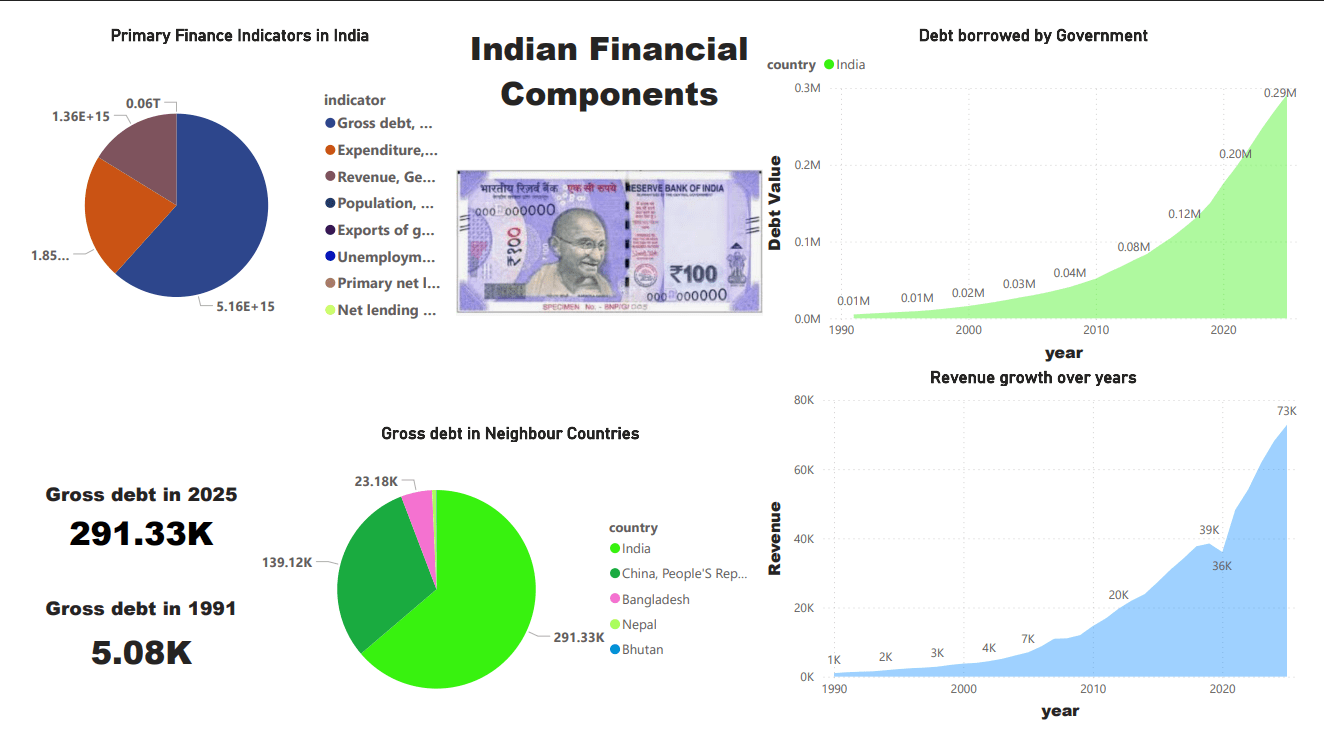
Over the past three decades, India’s government debt has grown at an accelerating pace. In the early 1990s, the country’s gross debt levels were relatively modest. The data shows a sharp transition from around 5K levels in 1991 to nearly 291K by 2025, marking an extraordinary expansion. This is not a gradual climb, it is exponential. The steep rise especially after the 2010s reflects increased borrowing to sustain growth, manage fiscal deficits, and respond to economic shocks such as the global financial crisis and the COVID-19 pandemic. While borrowing is not inherently negative, the pace at which debt has grown raises questions about sustainability. Specially , we can recall the saying,
“A government that borrows too much risks losing control over its future.” — Milton Friedman
When we place this trend next to India’s revenue growth, the imbalance becomes clearer. Government revenue has indeed increased over time, rising steadily from minimal levels in the 1990s to approximately 73K in recent years. However, this growth, while significant in isolation, pales in comparison to the surge in debt. Revenue is growing but not fast enough to keep up with borrowing. This widening gap implies that a larger portion of future revenue will be required just to service existing debt, leaving less room for development spending, welfare programs, or infrastructure investment.
The structure of India’s financial components further highlights this imbalance. Debt occupies the largest share in the financial composition, overshadowing other elements such as revenue, expenditure, and net lending. This dominance of debt indicates that the fiscal strategy of government is heavily reliant on borrowing rather than internally generated income. In the long run, such a structure can create vulnerabilities, particularly if economic growth slows or interest rates rise.
The situation becomes even more striking when India is compared to its neighbouring countries. Within the regional context, India’s debt stands disproportionately high. Countries like Bangladesh, Nepal, and Bhutan maintain significantly lower debt levels, reflecting more conservative fiscal management or smaller economic scales. Even China, despite being a much larger economy, shows a more balanced profile relative to its size. India’s position at the top of this comparison is not merely a function of scale, it reflects a heavier reliance on debt as a driver of economic activity.
Another important dimension is the trajectory of debt accumulation over time. The data shows that India’s borrowing has not just increased, it has accelerated. The curve becomes steeper in recent years, indicating that each successive period adds more debt than the previous one. This compounding effect can quickly lead to a situation where debt growth outpaces economic growth, a classic warning sign in macroeconomics. If unchecked, this trend can reduce investor confidence and increase the cost of borrowing, creating a cycle that is difficult to reverse.
At the same time, revenue growth, while upward, appears relatively smoother and slower. This mismatch between a rapidly rising debt curve and a steadily growing revenue line is critical. It suggests that India is not generating enough income to proportionately support its borrowing. In practical terms, this means higher fiscal pressure in the future,either through increased taxation, reduced public spending, or further borrowing.
What makes this situation particularly concerning is the external uncertainty in the global economy. IMF forecasts, which extend into future years, indicate continued growth in both debt and revenue. However, forecasts are based on assumptions that may not always hold true. Economic disruptions, geopolitical tensions, or domestic challenges could easily derail expected revenue growth while debt obligations remain fixed. This asymmetry increases financial risk.
India’s economy continues to expand and its revenue base is improving. But the IMF data reveals an underlying imbalance that cannot be ignored. Our nation’s heavy reliance on debt, especially when compared to its neighbours, signals a structural weakness in fiscal management. The widening gap between revenue and debt is a critical issue that demands attention. Sustainable growth will require not just expansion, but better alignment between what the government earns and what it owes. Without that balance, the current trajectory, though impressive on the surface, may lead to deeper financial challenges in the years ahead.