
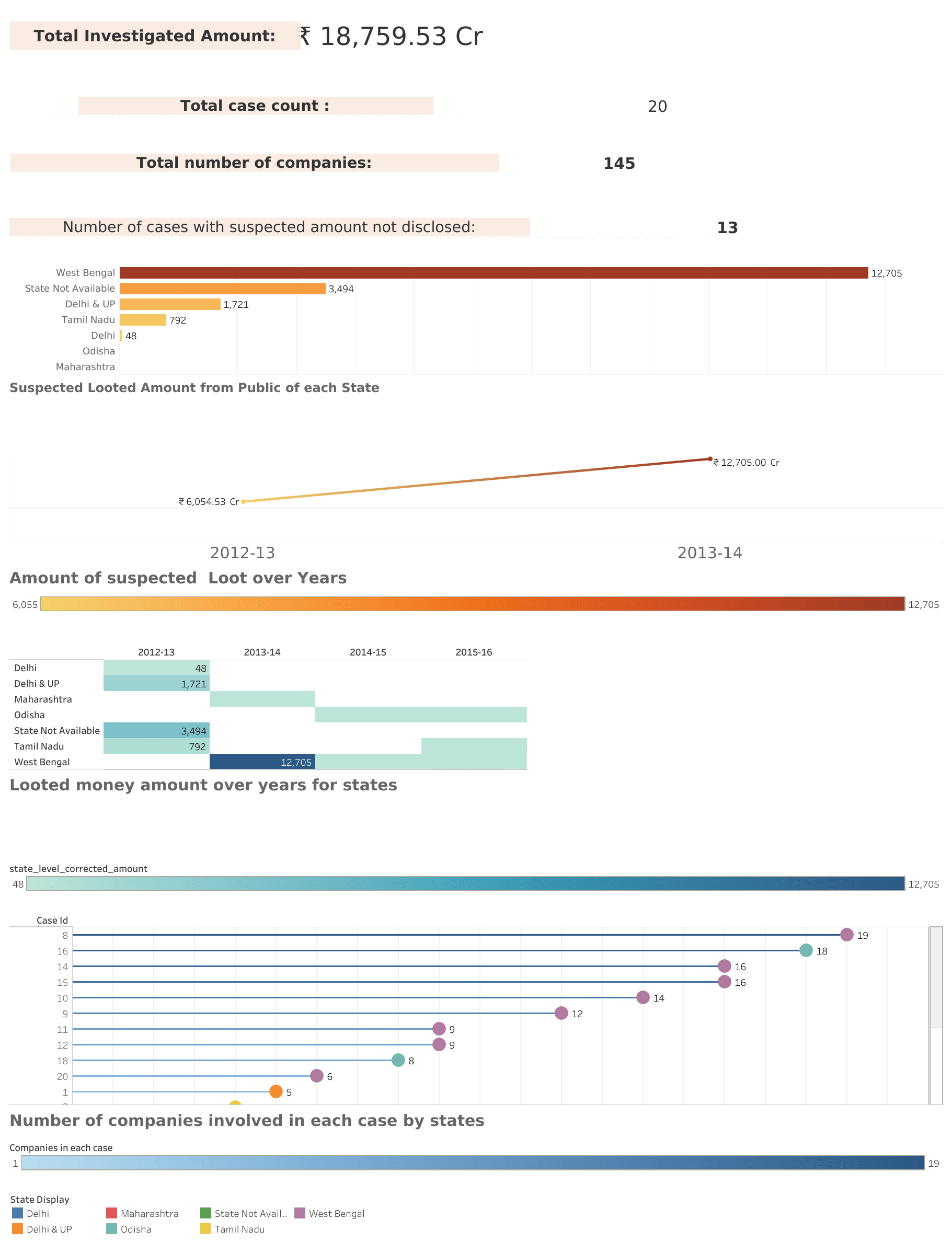
One of the most tragic thing happening is that our people are loosing their life-worth savings , by getting cheated on chit-funds. Over years, this damage has been continuous. Here is what the actual recorded number from government says.
“What gets measured gets managed.” — Peter Drucker
But what happens when a large part of what should be measured is simply not available?
This dashboard explores a set of companies listed as under investigation, based on information released through the Press Information Bureau in response to a parliamentary question answered by Arun Jaitley. At first glance, it looks like a structured list. Names, years, states, and suspected amounts. Yet, when we begin to read it closely, the data starts asking questions of its own.
The Weight of What We Know
The total suspected amount under investigation stands at ₹18,759.53 crore. It spans 20 distinct cases and involves 145 companies.
This alone is striking. But numbers do not exist in isolation. They need context, structure, and above all, completeness.
And that is where the story shifts.
The Weight of What We Do Not Know
“The greatest enemy of knowledge is not ignorance, it is the illusion of knowledge.” — Stephen Hawking
Out of the 20 cases, 13 do not disclose the suspected amount.
This is not a small gap. It is the majority.
So the ₹18,759.53 crore we see is not the full picture. It is only the visible part. The rest sits behind the label “not available”, a phrase that appears simple but carries deep implications.
Is the missing data small or massive? Is it deliberately withheld or simply not compiled? The dataset does not answer. And that silence becomes part of the narrative.
A Story of Concentration
When we look at where the disclosed amounts are concentrated, the imbalance is immediately clear.
One state, West Bengal, accounts for ₹12,705 crore, a dominant share of the known total. Another large portion is grouped under “state not available”, which itself reflects a lack of transparency in geographical attribution.
Other states appear, but their contributions are comparatively small.
“Power tends to concentrate. So does risk.”
This is not just a financial observation. It is structural. It suggests that the issue is not evenly distributed. Instead, it clusters, intensifies, and becomes visible in specific pockets.
Time Does Not Always Tell the Full Story
The timeline shows a sharp rise from ₹6,054 crore in 2012–13 to ₹12,705 crore in 2013–14.
At first, this looks like a surge. But then the trend stops. Later years show no values, not because nothing happened, but because the data is not disclosed.
“Absence of evidence is not evidence of absence.”
The pattern we see is shaped not only by events, but by reporting. The graph is as much about disclosure as it is about activity.
The Network Behind a Case
Perhaps the most revealing layer is not the amount, but the structure.
Some cases involve up to 19 companies. Others involve only a few. This variation is not random. It hints at something deeper.
“Things are not always what they seem; the first appearance deceives many.” — Phaedrus
A case is rarely a single entity acting alone. It is often a network. A cluster of firms, linked in ways the dataset does not fully explain, but strongly implies.
This transforms our understanding. We are not looking at isolated incidents. We are looking at systems.
Reading Between the Lines
What makes this dataset powerful is not just what it shows, but what it withholds.
A large total amount that is already significant
A majority of cases with undisclosed figures
A strong concentration in a few locations
Complex clusters of companies within single cases
“Not everything that can be counted counts, and not everything that counts can be counted.” — William Bruce Cameron
This is where data analysis becomes interpretation. The role of the analyst is not only to calculate, but to question.
A Final Reflection
This dashboard does not claim to uncover the entire truth. It does something more honest.
It shows what is known. It highlights what is concentrated. And it refuses to hide what is missing.
In doing so, it invites the reader to think beyond the numbers.
Because sometimes, the most important insight is not in the data itself, but in the spaces where the data stops speaking.
Source
Information is based on data released by the Government of India through the Press Information Bureau in response to a parliamentary question:
https://pib.gov.in